
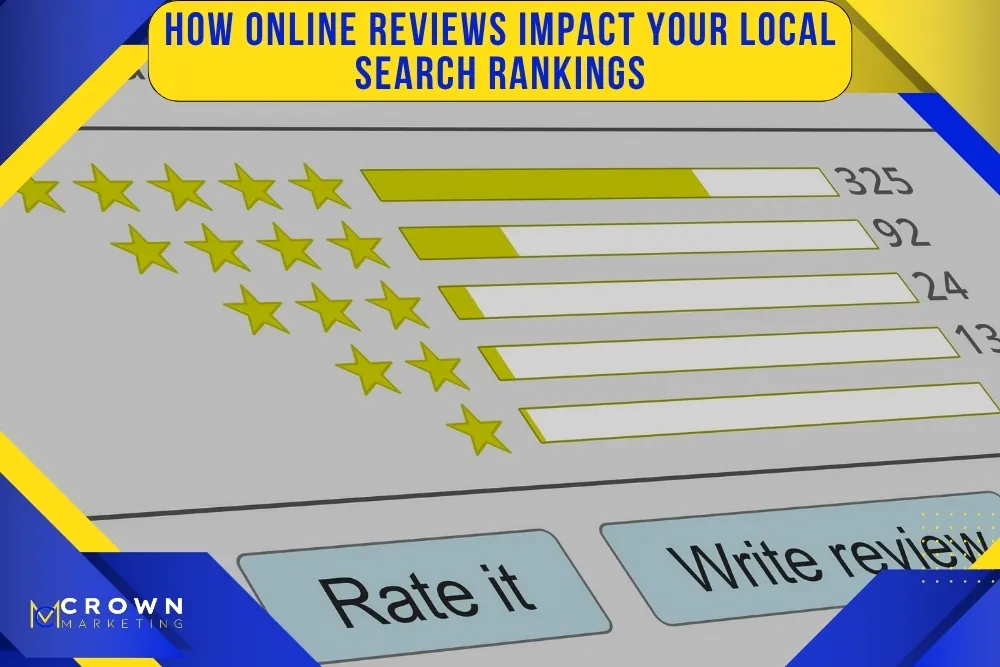
Online Reviews Shape Local Search Rankings and Customer Trust
When someone searches for a nearby service, reviews often become the deciding factor before that person ever visits a website. A strong rating, a steady stream of recent feedback, and professional owner responses can make one listing feel more credible than the next. For Las Vegas businesses competing in crowded local results, that first impression can directly influence calls, directions, bookings, and website visits.
Crown Marketing treats reviews as both a customer experience signal and a local visibility asset. Reviews do not operate alone, and no honest agency can promise that collecting a certain number will guarantee a top position. Still, they contribute to the prominence and trust surrounding a Google Business Profile while giving potential customers useful evidence about real experiences.
Review quantity, recency, and your response rate all factor into how Google ranks your business locally; this is a core part of our local SEO services. A healthy review program therefore needs more than an occasional request when someone remembers. It needs a simple process that staff can follow without pressuring customers or violating platform policies.
The business goal is not to chase stars at any cost. It is to earn honest feedback, learn from it, and make the public profile reflect the quality customers actually receive. When review management is connected to local SEO, service delivery, and clear communication, it can strengthen visibility and improve the chance that a searcher chooses your business.

How Review Quantity, Recency, and Relevance Support Local SEO
Searchers look for patterns. A business with many detailed reviews across several months usually feels more established than a listing with only a few old comments. Google also evaluates local results through relevance, distance, and prominence. Reviews can contribute useful context about the business and are one of the signals associated with prominence, but they do not erase distance or replace accurate profile information.
- Quantity shows a broader history: A larger collection of legitimate reviews gives customers more experiences to compare. The number should grow naturally through consistent service and respectful requests, not through incentives or purchased feedback.
- Recency shows that the business is active: New reviews reassure searchers that the company is still serving customers and maintaining its standards. A steady pace is usually more believable and useful than a sudden burst followed by months of silence.
- Relevance adds service context: Customers often mention what they purchased, the problem that was solved, or the area served. Those natural details help readers understand whether the business fits their needs without forcing keywords into a review request.
- Rating affects the first impression: A strong average can improve confidence, but customers also read the words behind the score. A realistic mix of detailed reviews may feel more trustworthy than a perfect rating with thin comments.
- Responses show active management: Thoughtful replies demonstrate that the business pays attention. They also give the owner a chance to thank customers, clarify a misunderstanding, and reinforce a professional tone in public.
Google’s own guidance says more reviews and positive ratings can help local ranking, while local results still depend on multiple factors. Business owners can review the official explanation of how Google determines local ranking for the current framework. The practical takeaway is to treat reviews as an important part of a broader local strategy rather than a shortcut.
Review Responses Can Reinforce Relevance and Build Confidence
Responding to reviews is one of the most visible ways a business can show that it values customer feedback. A reply should sound like a person, address the actual comment, and avoid copying the same generic line onto every review. Even a short response can feel meaningful when it acknowledges a specific detail.
Detailed, thoughtful responses to reviews can reinforce relevance for the services you offer. The response should not read like an advertisement. Natural service language may be appropriate when it directly relates to what the customer mentioned, but forced keyword repetition can make the business sound robotic.
Positive reviews deserve more than a rushed thank-you. Mention the employee, service, result, or experience the customer appreciated when it is appropriate and safe. For critical reviews, pause before replying. A defensive answer can draw more attention to the complaint, while a calm response can show future customers how the business handles difficult situations.
Responses also provide an internal learning loop. If several customers mention the same delay, confusing instruction, or standout employee, the pattern deserves attention. Review management becomes more valuable when the company uses feedback to improve operations instead of treating the profile as a one-way marketing channel.
Create response guidelines for tone, timing, privacy, and escalation, but leave room for a real voice. Staff should know which comments they can answer directly and which need management review. This protects the brand during emotional situations while keeping routine thank-you replies prompt and personal. It also reduces the temptation to paste identical responses that customers can recognize immediately. Review the guidelines whenever staffing, services, or policies change.

A Consistent Review Management System Protects Local Visibility
Most businesses do not struggle because customers refuse to leave reviews. They struggle because asking is inconsistent. One employee asks every satisfied customer, another never asks, and nobody checks whether the link works. A simple system can improve consistency without turning the customer relationship into an awkward sales script.
- Choose the right moment: Ask after the customer has received value, the issue has been resolved, or appreciation has been expressed. Timing should feel natural within the service experience.
- Make the path easy: Use a direct review link in a follow-up email, text, receipt, or thank-you message. Test it on mobile devices and confirm it reaches the correct profile.
- Invite honest feedback: Do not ask only customers expected to leave five stars, and do not offer rewards for positive reviews. A neutral request protects trust and supports platform compliance.
- Assign clear ownership: Decide who sends requests, who monitors new reviews, who drafts responses, and who approves replies to sensitive complaints. Ownership prevents reviews from sitting unanswered.
- Track the process, not just the score: Monitor request volume, response time, review recency, common themes, and profile actions. These measures reveal whether the system is functioning.
Reviews also influence click-through rates directly from search results, making them a key piece of our broader SEO services. Searchers may see the rating, review count, photos, business information, and competitors together. Strong feedback can help the listing earn attention, but the rest of the profile and website still need to support the promise.
Turning Review Data Into Better Marketing Decisions
Reviews can reveal how customers describe a service in their own words. Those phrases may identify questions, concerns, locations, or benefits that the marketing team has overlooked. They can inspire clearer service pages, better FAQs, stronger sales conversations, and more useful Google Business Profile updates.
- Group feedback by theme: Separate comments about service quality, communication, speed, staff, price, location, and outcomes. Repeated themes show what customers notice most.
- Compare locations or service lines: Multi-location businesses can identify where experiences differ. A strong pattern at one location may provide a process worth sharing elsewhere.
- Watch for content opportunities: Questions and misunderstandings in reviews can become blog topics, FAQ answers, videos, or profile posts that help future customers decide.
- Connect reviews to conversion behavior: Compare review growth and rating trends with calls, direction requests, website visits, and leads. Correlation is useful, but avoid claiming that reviews caused every change.
- Build a recovery process: Decide how serious complaints move from public response to private resolution. Fast, respectful follow-up can protect relationships and reveal operational issues.
Need a system for consistently generating reviews? Our digital marketing consulting team can help build one. The right system should match the customer journey, staff capacity, software, and approval process. It should also remain easy enough to use after the initial excitement fades.
A Las Vegas company with seasonal demand may need a different cadence from a professional service firm with longer client relationships. The most useful plan accounts for that reality. Consistency matters, but the request should always respect the customer and reflect the business honestly.
Online Reviews and Local Search Rankings FAQs
Do online reviews directly affect local search rankings?
Reviews are associated with local prominence and can help a business stand out, but they are only one part of local ranking. Google also considers relevance and distance, along with profile information and other signals. More positive reviews do not guarantee the first position, so review work should support a complete local SEO strategy.
How often should a business ask customers for reviews?
Ask consistently after appropriate customer interactions rather than running one large campaign and stopping. The right pace depends on transaction volume and customer relationships. A small professional firm may send a few requests each month, while a busy retailer or home service company may have opportunities every day.
Should keywords be included in owner responses?
Use service and location language only when it fits the customer’s comment and the natural response. Do not repeat a target keyword in every reply. The primary purpose is to acknowledge the reviewer, show professionalism, and provide helpful context for people reading the exchange.
What should we do with a negative review?
Confirm the facts, respond calmly, protect private information, and offer a reasonable path to continue the conversation offline. Avoid arguing or accusing the reviewer. If the review violates Google policies, use the proper reporting process, but do not assume a critical review will be removed simply because the business disagrees.
Is it acceptable to offer discounts for positive reviews?
No. Incentives tied to positive feedback can undermine trust and may violate platform rules. Ask for honest reviews without telling customers what rating to leave. The safest long-term strategy is to deliver strong service and make it easy for every eligible customer to share a genuine experience.
Strengthen Local Search Rankings With Crown Marketing
A strong review profile is built through good service, consistent requests, thoughtful responses, and careful analysis. When those habits work alongside accurate listings, useful content, technical SEO, and a clear website, reviews can help local customers feel more confident about choosing the business.
Crown Marketing helps Las Vegas companies connect review management to the rest of their digital strategy. We can assess the current profile, identify gaps in the request process, improve response guidelines, and track the actions that matter. The result is a practical system the team can maintain, not a short campaign that disappears after a few weeks.
Want to turn reviews into a ranking advantage? Contact Crown Marketing for a free local SEO consultation. You can also find our Las Vegas digital marketing company on Google Maps. We will look at your current reviews, profile, website, and local visibility so the next step is based on evidence rather than guesswork.