Woman-Owned & Veteran-Owned40+ Years Combined ExperienceLas Vegas, NevadaNo Contracts, Ever

Web & Digital Services Company

Marketing Automation And CRM Setup That Sales Will Use

Marketing Automation And CRM Setup That Sales Will Use2026-09-17T23:27:33+00:00

Marketing automation that removes work instead of adding a login

Most marketing automation gets bought as software and never becomes a system. The platform is paid for monthly, three workflows were built during onboarding, and the sales team keeps their real pipeline in a spreadsheet because the CRM does not match how they actually sell.

We build the boring, useful version. Leads captured from every source, routed to the right person in seconds, follow up that fires on its own, pipeline stages that match your actual sales process, and reporting that closes the loop back to the campaign that produced the deal. Built on whatever you already pay for, wherever that is possible.

Mapping lead routing and follow up automation into a CRM

Six parts of the setup

In the order that decides whether anyone uses it after month two.

Capture From Every Source

Forms, calls, chat, ads and referrals all landing in one place with the source attached. Leads scattered across three inboxes cannot be measured or worked properly.

  • Every source connected
  • Source recorded on the lead
  • Nothing landing in a personal inbox

Routing And Notification

Right owner, immediately, on their phone. Round robin, by service, or by territory. The rule matters less than the fact that somebody is clearly responsible within seconds.

  • Ownership assigned instantly
  • Mobile notification, not email only
  • Fallback if nobody responds

Pipeline That Matches Reality

Stages named after what actually happens in your sales process, not the platform defaults. If sales has to translate the CRM into their real process, they will stop updating it.

  • Stages from your real process
  • Required fields kept minimal
  • Built with the sales team, not for them

Follow Up Sequences

The messages that should send themselves: after an enquiry, after a quote, after silence, after six months. This is where most of the recovered revenue is.

  • Post enquiry and post quote
  • Quiet reactivation after months
  • Stops the moment they reply

Integrations

Calendar, quoting, invoicing, phone system and analytics wired together so nobody is retyping the same information into a second tool.

  • Built on tools you own
  • No duplicate data entry
  • Documented, not a black box

Closed Loop Reporting

Which campaign produced the deal that closed, not just the lead that arrived. This is the number that settles budget arguments and almost nobody has it.

  • Source carried to closed won
  • Pushed back to ad platforms
  • Cost per customer, not per lead

How automation actually gets adopted

The technical build is a fraction of the work. Getting it used is the rest.

Reviewing pipeline stages and automated follow up performance

Map the process before touching the software

We sit with whoever sells and write down what actually happens between an enquiry and a signed job. Almost every failed CRM implementation started by configuring the platform’s default process and then asking people to work differently. The tool should match the process, not the reverse.

Fewest required fields that still work

Every mandatory field is a small reason for a salesperson to skip updating the record, and skipped records make the whole system unreliable. We start with the minimum that supports reporting and add only when someone actually needs the data.

Speed to lead is the highest value automation

Contacting an enquiry within five minutes rather than an hour changes outcomes more than any nurture sequence. Routing to a named person, on their phone, with a fallback if nobody picks it up. We test that path monthly because notification delivery breaks quietly and nobody notices for weeks.

Automate the moments, not the relationship

After an enquiry, after a quote, after silence, after six months. Those should fire without anyone remembering. What must not be automated is the reply when a human writes back, which is exactly where over automated systems annoy the people you wanted to win.

Build on what you already pay for

Most of what businesses want is achievable with the software already on the invoice plus some connective work. We would rather wire together what you own than add another subscription, another login and another thing to renew and forget.

Then close the loop

Once outcomes flow back from the CRM into analytics and the ad platforms, you can see cost per customer instead of cost per lead. That single change frequently reverses which channel looks like the best investment, and it is the reason the setup work pays for itself.
Why clients stay with us

We are a small team on purpose. We build it with your sales team in the room, which is why they use it afterward.

  • Two owners on your project, working directly with whoever sells
  • Built on tools you already own wherever that is possible
  • 40+ years of combined experience across marketing, sales ops and web
  • Everything documented, including how to turn it off
  • Month to month support, no long term contracts

Case Study

Webster & Garino LLC

An Indiana law firm with an established brand and almost no organic presence. We rebuilt the site on WordPress, produced content and video at volume, fixed the technical foundation and built a real internal linking strategy.

+2,000%
Website traffic
+90%
Conversions

Clients across the country, and the reviews to back it up

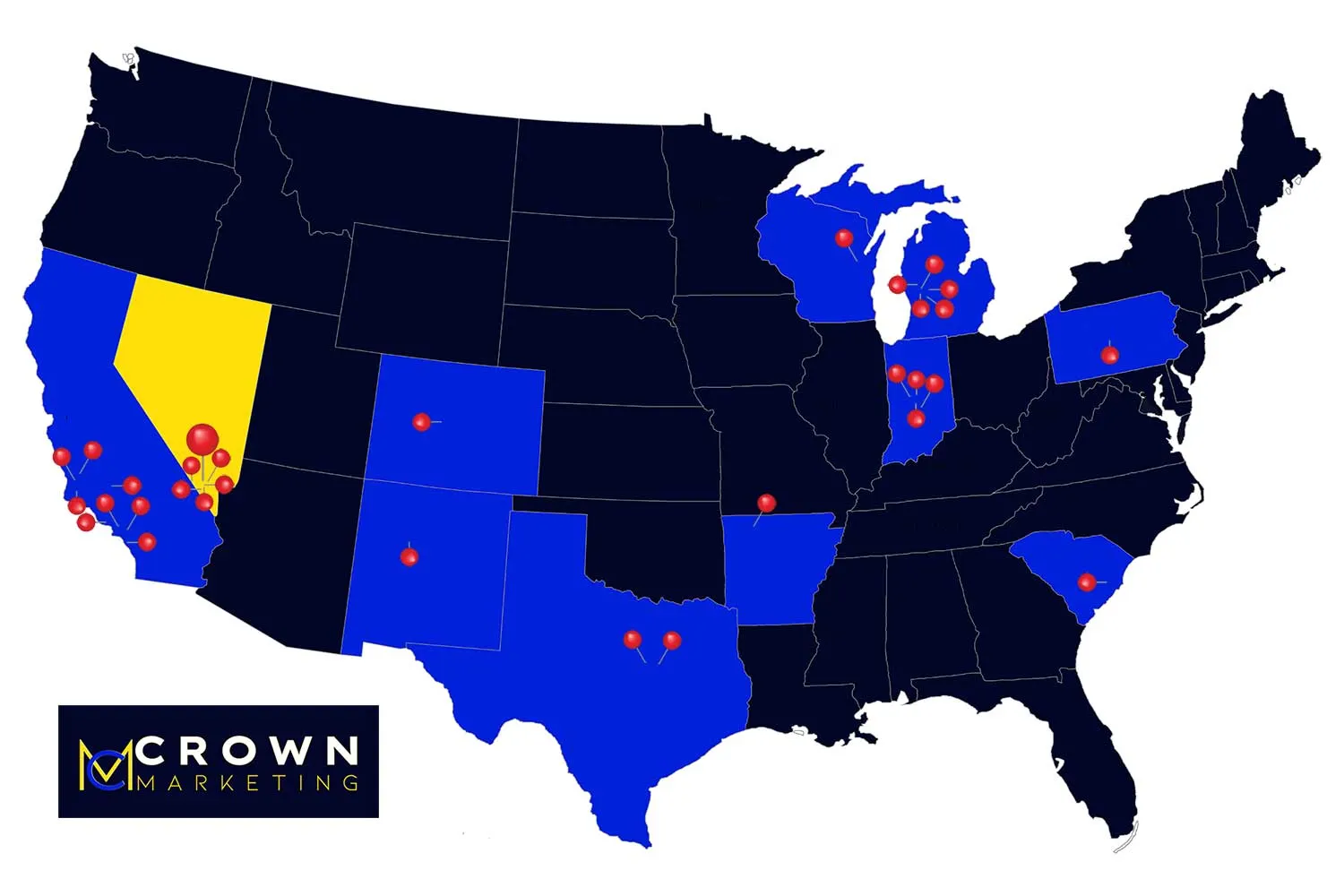
Every review is from a real client and every pin is a real market. We are based in Las Vegas and we run campaigns for clients in cities all over the country. The signals search engines read are the same everywhere, so the playbook travels.

Map of the United States showing the markets Crown Marketing runs local SEO campaigns in

Frequently asked questions about marketing automation

The things people ask on the first call, answered before you make it.

Whatever your team will actually update. HubSpot, Pipedrive, Zoho, GoHighLevel and Salesforce all work. The best CRM for a five person sales team is rarely the most powerful one, and migration costs more than people expect, so we would rather fix what you have.
Usually, and it is common. The reason is almost always that the pipeline stages do not match how people actually sell, or too many fields are required. Both are fixable in a few weeks and much cheaper than migrating.
A project fee based on the number of sources, integrations and sequences, commonly between 2,500 and 10,000. Ongoing support is monthly and optional. Software licences are yours and paid directly by you.
Three to six weeks for a typical setup including process mapping, build, testing and training. Complex integrations or a migration from an existing system add time.
No. It removes the administrative work around selling: routing, reminders, follow up, data entry. The conversations still belong to people, and the system exists so those conversations happen faster and with better information.
Usually. Most modern phone and call tracking systems integrate with common CRMs, and calls are often the majority of leads for a service business. If your phone system is genuinely closed, we will tell you what that costs you in visibility.
We document what every automation touches and keep a manual fallback for anything business critical. Building on tools you already own reduces exposure, and this is a real risk in this space rather than one we will pretend away.
Yes, and it is part of the project rather than an extra. A recorded walkthrough plus a live session, and written documentation, so a new hire in six months can be brought up to speed without calling us.
Where your CRM supports it, yes. Offline conversion import is one of the highest value things on this page because it lets the ad platforms optimize toward revenue rather than toward form fills.
Go to Top