
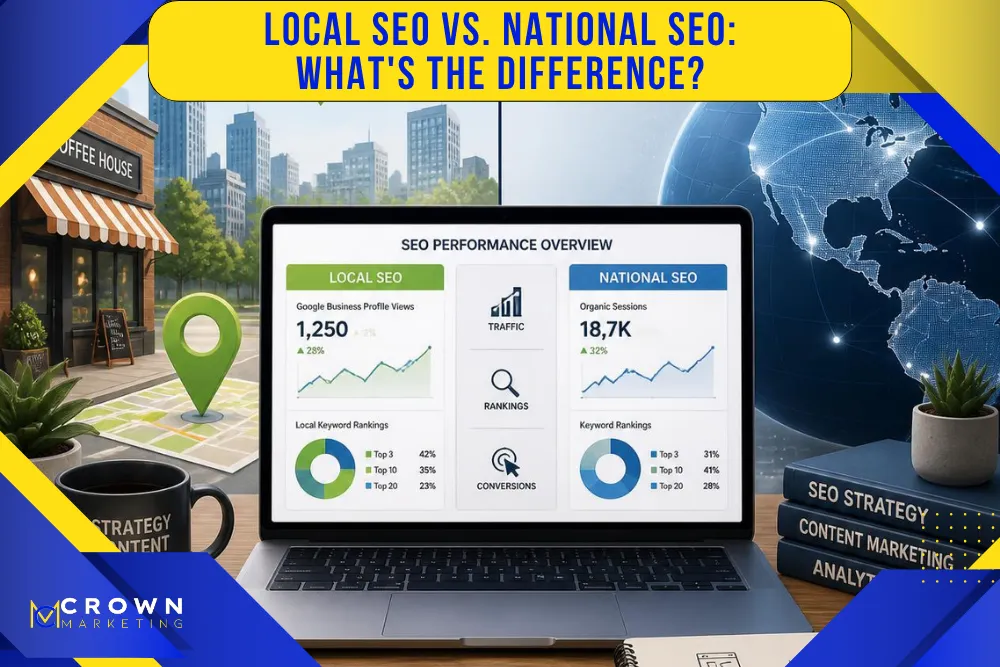
Local SEO vs. National SEO Starts With Knowing Who You Need to Reach
A strong SEO strategy starts with a simple question: where are your best customers searching from? For a Las Vegas business that depends on calls, appointments, store visits, or service-area leads, local SEO usually deserves immediate attention. A company that sells products or services across the country has a different challenge. It needs to compete for broader terms, build authority beyond one market, and create content that can win against national brands.
Crown Marketing approaches local SEO and national SEO as two different paths that can support the same business goal. The right choice depends on geography, competition, sales process, budget, and how customers actually find you. A Las Vegas contractor, attorney, medical provider, restaurant, or home-service company usually benefits from strong local visibility first. A software company, e-commerce brand, manufacturer, or specialized consultant may need a wider national reach.
The difference matters because search engine optimization is not just about getting more traffic. It is about getting the right traffic. A smaller number of qualified local visitors can be far more valuable than thousands of broad visits from people outside your service area. The best plan connects rankings to real business outcomes such as calls, forms, booked consultations, and revenue.

Local SEO Focuses on Geography, Maps, and Local Intent
Local SEO is designed to help a business appear when searchers include a city, neighborhood, “near me” phrase, or other local intent. It also supports visibility in Google Maps and the local map pack. For service businesses in Las Vegas, that means building clear geographic relevance while giving Google consistent signals about who you are, what you offer, and where you operate.
- Your Google Business Profile matters. Categories, services, photos, reviews, hours, and accurate contact details help Google connect your business with local searches. Profile activity should support the information on your website rather than contradict it.
- Location and service-area pages create stronger geographic relevance. Useful pages explain the service, the area served, common customer needs, and what makes the business a credible local option instead of repeating the same paragraph with a different city name.
- Local citations and consistent business information reduce confusion. Your name, address, phone number, and website should match across major directories, map listings, industry sites, and social profiles.
- Reviews influence both trust and local visibility. A steady flow of recent, detailed reviews can help potential customers choose between businesses that appear side by side in local results.
- Internal links help search engines understand priority pages. Linking related service, location, and educational pages gives both users and Google a clearer path through the site.
Local SEO focuses on ranking for searches tied to a specific city or region, which is the focus of our local SEO services. For many Las Vegas companies, this is the fastest route to improving visibility among people who can actually become customers.
National SEO Competes for Broader Search Demand
National SEO removes much of the geographic limitation. Instead of trying to rank for “SEO company Las Vegas,” a national campaign might target broader terms such as “SEO services,” “conversion tracking,” or a specialized product category. The opportunity is larger, but the competition is usually much tougher.
- Keyword difficulty rises quickly. National terms attract established companies, publishers, marketplaces, and brands with large content libraries and strong backlink profiles.
- Content depth becomes more important. One service page is rarely enough to compete nationally. Businesses often need supporting guides, comparison pages, case studies, FAQs, and topic clusters that demonstrate authority.
- Backlinks and brand mentions carry more weight. National competitors often have years of links from industry publications, partners, associations, and news sites, so authority-building becomes a larger part of the strategy.
- Search intent must be matched precisely. Broad keywords can attract researchers, students, competitors, and people who are not ready to buy, so pages need to be designed around the specific intent behind each query.
- Measurement should go beyond rankings. A national campaign needs to track qualified organic leads, assisted conversions, revenue, and which content paths contribute to sales rather than celebrating traffic alone.
National SEO targets broader, often more competitive keywords; our full SEO services team can help determine which strategy fits your business. Broader reach can be valuable, but it needs the budget and content support to compete consistently.

SEO Strategy Differences Affect Content, Competition, and Measurement
The biggest mistake is assuming local and national SEO use the same playbook with different keywords. They share technical fundamentals, but the way pages are planned, optimized, and measured can be very different. A business should know what success looks like before investing months into content and optimization.
- Local campaigns prioritize map visibility, service areas, city relevance, reviews, and calls from nearby customers. National campaigns prioritize topical authority, broader keyword coverage, backlinks, and conversion paths that work across markets.
- Local content often answers practical questions tied to a place, such as availability, neighborhoods served, regulations, travel distance, or seasonal needs. National content usually has to answer a broader question better than high-authority competitors.
- Local competition may be limited to a few dozen serious businesses in one metro area. National competition can include hundreds or thousands of sites, making content quality and authority much harder to replicate quickly.
- Local reporting should track map pack visibility, calls, directions, form submissions, and location-page performance. National reporting should also examine nonbrand organic growth, assisted conversions, topic clusters, and revenue from wider audiences.
- Budget should reflect the size of the market. A modest local campaign can produce meaningful results in one city, while national SEO often requires sustained content production, technical work, outreach, and testing over a longer period.
Google’s SEO Starter Guide emphasizes building helpful, accessible pages for users and making it easier for search engines to understand a site. Those fundamentals apply to both strategies, even though the competitive environment is different.
Search Engine Optimization Often Works Best With a Blended Approach
Many businesses do not fit neatly into one category. A Las Vegas company may depend on local customers today but want to expand into Phoenix, Southern California, or a national niche later. In that case, local SEO can create a strong base while broader content builds authority over time.
A blended strategy starts by protecting the pages closest to revenue. Service pages, core location pages, conversion tracking, and Google Business Profile visibility should be solid before a company spends heavily on broad informational content. Once that foundation is working, the site can expand into national topics that attract a wider audience without weakening the local message.
Many businesses benefit from a blended approach; our technical SEO services ensure your site’s foundation supports both. Site architecture, crawlability, speed, mobile usability, internal linking, indexing, and structured content all matter whether the target customer is five miles away or five states away.
The key is avoiding mixed signals. A page should have a clear purpose, audience, and conversion goal. Trying to force every page to rank locally and nationally can make the copy vague. Separate pages can serve different search intents while still supporting one overall brand and business strategy.
A practical way to manage the blend is to map keywords before writing. Group local terms around services and locations, then reserve broader informational and commercial terms for pages intended to reach a wider audience. This reduces keyword overlap and makes internal linking more deliberate. It also helps a team decide which pages deserve updates first when rankings change. When every page has a defined role, reporting becomes easier because traffic, engagement, and conversions can be compared against the page’s intended audience rather than judged by traffic volume alone.

Local SEO vs. National SEO FAQs
Is local SEO only for businesses with a storefront?
No. Local SEO also matters for service-area businesses that travel to customers, including contractors, home-service companies, mobile providers, and professional services. The strategy may use a hidden address on the Google Business Profile when appropriate, but the website still needs clear service-area information and local relevance. A local strategy can also support multiple service areas when each market is represented accurately and the content is useful to people in that area.
Can a business target local and national SEO at the same time?
Yes, as long as the site structure separates the goals clearly. Core service and location pages can target local intent while resource content, guides, and broader service pages target national searches. The important part is making sure each page has one primary purpose and does not compete with another page for the same keyword.
How long does local SEO take compared with national SEO?
Timelines vary by competition, site condition, content quality, and authority. Local improvements can sometimes show sooner because the competitive set is smaller, especially when a business has a strong profile and good reviews. National SEO usually requires more time because broad terms attract stronger competitors and demand more authority.
Does Google Business Profile help national SEO?
A Google Business Profile primarily supports local visibility, but it can still strengthen trust and brand signals for a company that also competes nationally. It should not replace national content or link building. Think of it as one local asset within a larger search strategy.
Which SEO strategy is better for a Las Vegas business?
The better strategy is the one that matches where revenue comes from. If most customers are in Las Vegas and nearby communities, local SEO should usually come first. If the company sells nationally or serves clients remotely across the country, national SEO may deserve more investment. Many businesses eventually use both.
Choose the SEO Strategy That Matches Your Growth Goals
Local and national SEO are not competing ideas. They are different ways to connect search visibility with business opportunity. The right plan begins with your service area, customer behavior, competitive landscape, and sales goals, then builds pages and measurement around those realities.
Crown Marketing can help you decide where local SEO should lead, where national content makes sense, and how to build a strategy that does not waste effort on traffic that will never convert. If you are looking for a Las Vegas digital marketing company that can connect search strategy to calls, leads, and real business growth, we can help.
Not sure whether to focus locally or nationally? Contact Crown Marketing for a free SEO consultation. We will look at your market, website, competitors, and current visibility, then recommend the path that makes the most sense for your goals.