
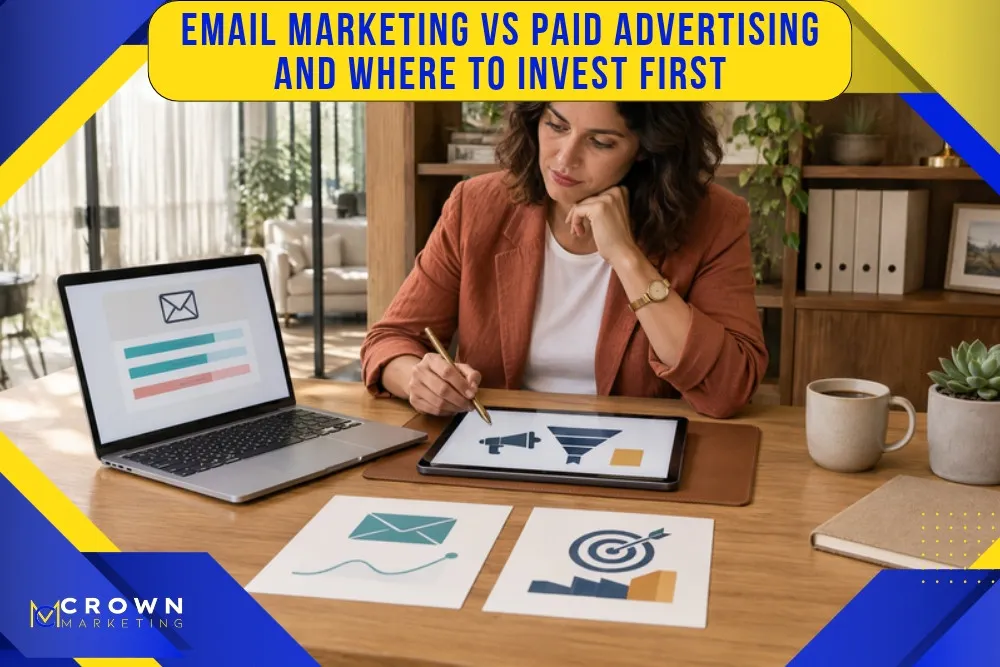
Email Marketing vs Paid Advertising and Where to Invest First
Email Marketing and Paid Advertising Solve Different Growth Problems
Crown Marketing helps businesses compare email marketing and paid advertising by starting with the result they need next. Both channels can generate revenue, but they work from different assets and timelines. Email uses an audience the business has already earned permission to contact. Paid media rents immediate access to people based on searches, interests, behavior, or demographics.
Email is strongest when a company has a healthy subscriber list, a useful offer, and a reason to stay in touch. It can nurture leads, bring customers back, support launches, and share information at a relatively low cost per send. Its limitation is reach. A campaign cannot influence people who have never subscribed or whose addresses are outdated.
Paid advertising can create visibility quickly. Search ads can meet people who are actively looking for a solution, while social and display campaigns can introduce an offer to selected audiences. The tradeoff is ongoing media cost. When spending stops, most paid traffic stops too, so the landing page and follow-up process must make each click worthwhile.
The first investment should match the current constraint. A business with thousands of engaged contacts but inconsistent communication may gain more from email. A new company with no list and an urgent sales target may need paid acquisition. The decision becomes clearer when leaders compare audience access, offer readiness, sales timing, tracking, and marketing budget.

Evaluate Audience Data Timing and Marketing Budget
Channel choice should be based on evidence rather than habit. Before assigning money, review the audience data already available, the speed at which results are needed, and the team’s ability to respond to leads. The following questions reveal which channel has the stronger starting position:
- Measure the usable email audience, not the total database. Remove invalid addresses, review recent opens and clicks, and identify customers or prospects who have given clear permission to receive messages.
- Estimate the cost of paid reach in the target market. Search volume, competition, location, audience size, creative requirements, and platform fees can all change the amount needed for a meaningful test.
- Define the conversion that matters. A retail campaign may focus on purchases, while a professional service may need qualified calls, consultations, or form submissions rather than inexpensive clicks.
- Match the timeline to the buying cycle. Paid media can create visits quickly, but a complex sale may still require weeks of education. Email can support that follow-up when the first interaction does not close.
- Confirm that the team can handle demand. More leads do not help when calls go unanswered, sales follow-up is slow, inventory is unavailable, or appointment capacity is already full.
A realistic marketing budget includes more than platform spend. Allow for strategy, copy, design, landing page work, tracking, testing, and follow-up. Email software may look inexpensive, but weak segmentation or rushed content can waste the audience’s attention. Paid ads may launch fast, but poor measurement can turn the budget into traffic with no clear business outcome.
Set a test period and decision rules in advance. Agree on the amount that can be invested, the minimum data required, and the metrics that will determine whether to continue, revise, or stop. This prevents one strong day or one disappointing week from controlling the entire strategy.
When Email Marketing Deserves the First Investment
Email marketing often deserves priority when a business has an established list and opportunities for repeat purchases, renewals, referrals, education, or long sales cycles. The channel can increase the value of relationships that already exist without paying again for every visit.
Look for these conditions before making email the first investment:
- The subscriber list includes recent customers, qualified leads, or active members who recognize the brand and have a clear reason to care about future messages.
- The business can segment contacts by purchase history, service interest, location, lifecycle stage, or engagement so each message is more relevant than a generic newsletter.
- There is useful content to send, such as practical guidance, new resources, event reminders, product updates, customer education, or timely offers tied to genuine needs.
- The website has clear landing pages and forms that continue the message after the click. Strong website content services can reduce gaps between the email promise and the destination.
- The team can maintain a dependable schedule and measure delivery, clicks, conversions, unsubscribes, and revenue without overreacting to a single campaign.
Begin with a simple program rather than an elaborate automation map. A welcome sequence, monthly educational message, and targeted follow-up for a high-value segment can reveal what the audience responds to. Once the basics perform reliably, add lifecycle campaigns for abandoned inquiries, post-purchase support, renewals, or re-engagement.
List quality matters more than list size. Buying addresses or emailing people without permission creates legal, deliverability, and trust risks. Sustainable growth comes from clear signup expectations, useful incentives, and consistent value. Each message should make the relationship more helpful, not merely increase sending frequency.

When Paid Advertising Should Lead
Paid advertising should often lead when the business needs new audience reach, has a time-sensitive offer, or can identify high-intent searches with commercial value. It can also support a launch in a market where organic visibility and subscriber growth are still developing.
A paid program needs a focused offer and a destination built for that offer. Sending every campaign to a general homepage forces visitors to search for the next step. Dedicated landing pages can match the ad message, answer the most likely objections, and make the conversion action obvious.
Search campaigns are useful when people already know how to describe the problem. Social advertising can be better for visual offers, awareness, retargeting, and audiences defined by interests or behavior. The platform should follow the customer, not a trend. A PPC company or internal buyer should explain why the chosen channel fits the buying journey.
Budget pacing should reflect the amount of data required to learn. A very small daily budget spread across many audiences, keywords, and creative versions may produce no reliable conclusion. Start with a narrow hypothesis, protect irrelevant searches with exclusions, and measure the actions that indicate business value.
Paid media also creates information that can improve other marketing. Search terms can reveal customer language, ad tests can identify stronger value propositions, and landing page behavior can expose confusing content. Those insights remain useful even when the campaign changes.
Before scaling, inspect lead quality with the sales team. A campaign can look efficient when forms are inexpensive but contacts are outside the service area, unqualified, or impossible to reach. Feed those findings back into keywords, audiences, exclusions, offers, and landing page questions so optimization follows revenue potential rather than surface activity.

Build a Blended Digital Marketing Plan
For many businesses, the strongest answer is not email or paid advertising alone. Paid campaigns can attract new prospects, while email continues the conversation after they request a guide, create an account, attend an event, or begin an inquiry. Email can also reactivate existing customers so paid spend focuses on truly new demand.
Use these operating principles when combining channels:
- Give each campaign one primary job. Acquisition ads, lead nurturing emails, customer retention messages, and retargeting campaigns should have separate goals even when they support the same revenue target.
- Keep the promise consistent from ad or email to landing page. Headlines, offer details, imagery, deadlines, and calls to action should reinforce one another instead of making visitors question what changed.
- Use shared measurement across channels. Track source, campaign, landing page, qualified lead, sale, and customer value so the team can see which combinations create profitable outcomes.
- Coordinate frequency and exclusions. Recent buyers may need onboarding instead of acquisition ads, and highly engaged email subscribers may not need to see the same promotional message everywhere.
- Review the full customer journey with experienced digital marketing consulting support when attribution, sales follow-up, and channel responsibilities are unclear.
A blended plan should still have priorities. Do not launch every tactic at once. Choose the channel most likely to remove the current constraint, then add the second channel when there is a clear handoff. The broader set of digital marketing services should work as a connected system rather than a collection of unrelated campaigns.
Monthly reviews should compare efficiency and quality, not just volume. A channel that produces fewer leads may create better customers, higher retention, or faster sales. Use cost per qualified opportunity, conversion rate, revenue, and customer value alongside opens, clicks, impressions, and form fills.
Email Marketing vs Paid Advertising FAQs
Is email marketing cheaper than paid advertising?
Email usually has a lower marginal cost once a healthy list and production process exist, but it is not free. Software, strategy, writing, design, testing, and list maintenance require resources. Paid advertising adds media spend but can reach people the business does not already know. Compare total cost with qualified results rather than comparing platform fees alone.
How much should a small business spend on paid advertising?
The right amount depends on market competition, average sale value, conversion rate, geography, and the data needed for a useful test. Start with a budget the company can sustain through a defined learning period. Limit the first campaign to a focused audience and outcome so the available spend produces interpretable results.
How often should a business send marketing emails?
Send as often as the audience can receive genuine value and the team can maintain quality. A monthly message may suit a long consideration cycle, while ecommerce or events may justify more frequent campaigns. Watch engagement, complaints, unsubscribes, conversions, and segment behavior, then adjust frequency instead of following a universal schedule.
Can paid advertising help build an email list?
Yes. Ads can promote a useful guide, event, assessment, discount, or other clear exchange for permission to follow up. The landing page should explain what subscribers will receive and how often. Avoid collecting addresses with a weak incentive and then sending unrelated promotions, because that damages engagement and trust.
Which channel produces results faster?
Paid advertising can generate visibility and visits as soon as a campaign is approved, but profitable results still depend on targeting, offer quality, landing pages, and sales follow-up. Email can produce fast responses from an engaged list, yet building that audience takes time. The fastest channel is the one with the strongest existing foundation.
Choose the Channel That Supports the Next Business Goal
The choice between email marketing and paid advertising is a resource decision, not a contest with one permanent winner. Email builds value from relationships a business already owns. Paid media buys access to new or immediate demand. The first investment should address the biggest gap in the current customer journey and include a plan for measuring business outcomes.
Crown Marketing can evaluate audience data, offer readiness, landing pages, tracking, and sales goals before recommending a channel mix. Learn how a Las Vegas digital marketing consulting team approaches local growth, then contact Crown Marketing for a free marketing consultation. A clear first priority makes it easier to test responsibly, learn quickly, and build a system that can expand.